I saw a television commercial yesterday for a chain restaurant, promoting its offer of unlimited shrimp. What it sees as a great temptation, I see as gluttony and a reflection of just how far we’ve gone down the wrong path.
I’m a firm believer that you get what you pay for. The current economy is bad—I feel it as much as you do—but I’m absolutely unwilling to compromise quality for quantity.
Sure, you can pay $8 and stuff your face with non-organic shrimp bathed in a high-sodium, high-fat glaze—and perhaps a few non-organic, over-cooked veggies thrown in for “good” measure—but what you’re getting in return for your investment are unappetizing side effects like exposure to toxins and pesticides, indigestion, and fatigue.
Think about it this way: Is someone really going to offer an unlimited amount of quality?
A national morning news show recently highlighted a family that feeds itself from a most meager budget each week. The family was celebrated for cutting corners and cutting costs. In my eyes, it was also honored for cutting nutrition. I’d rather hear about a family that cleverly manages to find the most affordable sources for fresh, local, and organic fare . . . where the parents have oodles of energy and no health problems . . . and where the kids have no trouble concentrating in school.
Don’t be fooled by promotional gimmicks and advertising propaganda. You and your family deserve real nutrition—it might not be offered in “unlimited” quantities but, I assure you, the quality is priceless.
Question of the blog: Has the bad economy forced you to sacrifice your eating habits?
Tuesday, September 9, 2008
Is There an End to “Unlimited”?


Monday, September 8, 2008
Are Pesticides Really Peopleicides?
I don’t remember when I first heard of organic food—certainly, it was many years ago—but the idea instantly resonated with me. Exposing ourselves to harmful chemicals designed to kill isn’t exactly appetizing.
Back then, organic fruits and vegetables weren’t just hard to find, they were expensive. Now, they are in almost every grocery store and often quite affordable (if you’re a bargain shopper like me, you know just where to go to get the best deals; I often pay less for organic food than the conventional counterparts).
So, why go organic?
A. It’s Healthy. By eating organic fruits and vegetables, you’ll limit your exposure to pesticides by as much as 90 percent; these toxins attack your immune, nervous, and reproductive systems and are especially bad for fetuses, young children, and the elderly.
B. It’s Really Healthy. Four years ago, a research associate with the Biochemical Institute at the University of Texas, Austin, published analysis of data collected by the USDA in 1950 and 1999 on the levels of 13 nutrients in more than 40 food crops. The results: after the addition of pesticides and breeding techniques (for oh-so-important criteria like rapid growth and storage life) the protein in the conventional crops declined by six percent; phosphorous, iron, and calcium declined between nine percent and 16 percent; ascorbic acid declined 15 percent; and riboflavin declined 38 percent. In organic crops, those nutrients are still there!
C. It Just Tastes (& Looks) Better. This weekend, Mark and I bought local, organic apples and I wish I could share our bounty with you. The fruit is crisp, sweet, and firm . . . and it isn’t shiny from wax and other add-ons.
So which fruits and vegetables are the most contaminated? The Environmental Working Group's “Dirty Dozen” list answers that question. These are the 12 most popular fruits and vegetables that have the highest levels of toxic pesticides:
1.Peaches: Over 94 percent tested positive for traces of 45 different pesticides.
2.Celery: 94 percent tested positive for 29 different pesticides.
3.Apples: 92 percent tested positive for 36 pesticides.
4. Sweet Bell Peppers: 68 percent tested positive for 39 different pesticides.
5.Cherries: 91 percent tested positive for 25 different pesticides.
6.Imported Grapes: 86 percent tested positive for 35 different pesticides.
7.Nectarines: 97 percent tested positive for 26 different pesticides.
8.Pears: 94 percent tested positive for 35 different pesticides.
9.Potatoes: 79 percent tested positive for 29 different pesticides.
10.Raspberries: 59 percent tested positive for 39 different pesticides.
11.Spinach: 83 percent tested positive for 36 different pesticides.
12.Strawberries: 90 percent tested positive for 36 different pesticides.
92 percent of conventional apples tested positive for 36 pesticides! With that in mind, I’d like to amend the old adage: an organic apple a day keeps the doctor away.
Question of the blog: Do you think pesticides are peopleicides?
Monday, July 21, 2008
Looking for a Stylish Green Bargain?
 A quick tangent: You know how, when you learn a new word, you hear it all the time? Okay, back to my story. So the day after I learn of prAna, Mark and I go to our local EMS store. Like a moth to the flame, I’m pulled to the clearance rack . . . and I find (what else?) prAna shirts and pants on sale.
I bought a prAna, 100% organic, Made-in-the-USA, raspberry tie-dyed tank top for 75% off. [I’m wearing it today and just snapped this picture.]
Finding stylish, organic, USA-made clothing on sale is my shopping Holy Grail, and I’m excited to share my best finds with you. Here's a link to the search results for prAna at EMS.
Question of the blog: Do you have a favorite eco clothing line?
Friday, July 18, 2008
Can Going Green Improve a Relationship?
I was just thinking about some of the ways being environmentally friendly has made my utterly fantastic marriage even better.
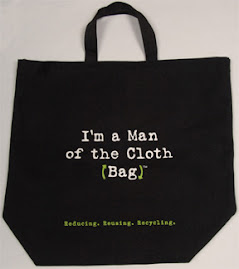
For me, there’s (almost) nothing sexier than my husband, Mark, wearing an organic, Made-in-the-USA t-shirt and shopping at our local Farmer’s Market with his “I’m a Man of the Cloth Bag” tote from EcoVixen.com.
Ahem. But I digress. Here’s a little (organic) food for thought:
The Top 10 Ways Going Green Improves a Relationship
10. With all the money you save at the pump driving a hybrid, you can still afford to go out on the weekends.
9. With all the money you save buying local fruits and veggies, you can still afford to go out during the week.
8. Two words: organic wine (and don’t forget making a toast with green glassware).
7. You traded your conventional, and toxic, bed for an all-natural mattress and pillows and organic sheets (in other words, you transformed your bed into the kind of healthy nest you’ll never want to leave—wink, wink).
6. Two words: soy candlelight (mood lighting often equals in-the-mood lighting).
5. Preparing healthy, organic, from-scratch meals—with all those local fruits and veggies you bought—is code for “I love you.”
4. Two words: Home Depot (this “happy husband equals happy wife” hang-out has myriad green options).
3. You removed the television from your bedroom to save electricity. Now, when you’re in bed, there are other things you can do . . . like talk.
2. Three words: sexy eco underwear (so you don’t just talk in bed).
1. You’ve got the low-flow showerhead and you’ve reduced your showers to five minutes. To save even more water, you can shower together.
Question of the blog: How has going green improved your relationship?
Tuesday, July 15, 2008
What Would Happen if Coca-Cola Was Banned?
Someone asked me recently how he should go about going green. I’m sure he expected me to name the usual suspects—like energy-efficient light bulbs—but here’s what I said:
The best way to go green is to start asking questions.
“What do you mean?” he asked.
“Perfect,” I answered. “You’ve gotten into the question-asking spirit already!”
What I meant is that going green isn’t just about what you buy or don’t buy. It’s about a new way of looking at life in general, and your life in specific. It’s about holding up old beliefs to the light to see just what’s there—truth or a spider web of lies.
And then it’s about changing your behavior based on what you find.
The greener you become, the less tolerant you are for untruths in all areas of your life. At least, that’s how it’s been for me. Going green has been my passion for nearly two decades. I see the world through green-colored glasses . . . and sometimes what I see frustrates and alarms me.
But at least I see.
I see Europe and Canada years ahead of us in the testing they’re doing and the laws they’re passing. I see big business in this country convincing the government to do things in the worst interest of its citizens. Here’s a question: Where’s the outrage?
If Congress banned the sale of Coca-Cola, the country would be up in arms. There would be demonstrations, people would call their Senators and Representatives, chaos would ensue. But when Congress, say, blocks a proposal that would have extended the tax breaks that have either expired or are scheduled to end this year for alternative energy development (like solar and wind) and for the promotion of energy efficiency and conservation (which they did last month: http://goinggreen-forlife.blogspot.com/2008/06/what-fck.html) no one makes a peep.
I read recently that the Australian landscape has changed so much over the last few years because of the climate change—indigenous trees no longer grow, many birds are gone—that Aussies are becoming depressed. Life has changed for them, and it's changing for us, too.
In times of change, I understand wanting to hold onto the familiar. Coca-Cola is equated with "classic" American life, but how important will that Coke be when the trees stop growing and the birds are gone?
The good news is that we—every single person—can make a difference. We can’t wait for the US government to see what’s so painfully obvious and be the "leader" it's supposed to be. We can start questioning everything (and I mean everything) and then changing what we can.
That spirit is, after all, as American as organic apple pie!
Question of the blog: Do you think the next US administration will finally begin to make the necessary environmental changes?
Monday, July 14, 2008
Got a Green Realtor?
Mark and I have our house on the market. In my part of the country, finding an environmentally friendly home is quite the challenge. Finding an environmentally friendly realtor is as well . . . although I don't think that's specific to my hometown.
I have been very up-front with my realtor about my green wishes (I’m sure he calls them “demands” but let’s not go there). When he hosted an Open House, I asked that he forgo the plastic plates and utensils and use my dinner plates and silverware instead. And, after showings, he gets a call from me if any lights are accidentally left on.
Last Friday, I was in Western Massachusetts for work and, during a moment of downtime, I thumbed through a Homes & Land catalog and was impressed to find an ad for EcoRealty (www.ecorealty.org).
According to their site, EcoRealty has a “keen interest in and fairly broad knowledge of environmental health issues, knowledge of green building, and belief in sustainable development.” In addition, they give 10 percent of their after-tax profits to “support local farming groups and land conservation funds.”
Their site also contains some really interesting and useful information. I specifically like their insight on creating a “healthy house” (www.ecorealty.org/HHFact.htm).
Question of the blog: Would you search out a green realtor?
Thursday, July 10, 2008
Is a (Fake) Rose Still a (Fake) Rose?
You might have heard—or, likely, seen—that Walmart changed its logo. In place of its star is a symbol that looks like a flower or the sun.
To quote an article on MSN.com, “The redesign looks like an effort to advance the discount retailer's reputation as environmentally friendly. But can it repair an image?”
I’m sure you know how I feel.
Walmart may be the world’s biggest purchaser of organic cotton, but I dare you to go into a store and find many organic cotton products . . . or even one. I’ve forced myself into several stores to see what happens when I ask a clerk to direct me to the organic cotton products.
Not once has someone been able to rise to the simple challenge.
Forget about the logo, though, and let’s talk about Walmart’s tagline: Save money. Live better. Every time I see a Walmart commercial that ends with the line, I have to laugh. This isn’t an A = B proposition. Saving money doesn’t make you live better, especially when you’re saving all that money buying products made overseas, filled with chemicals, and otherwise bad for your health.
I’d like to ask Walmart to define its definition of living better.
I get that the economy is bad, but we’re not going to make it better by supporting other countries and making ourselves sick. I went to the Farmer’s Market this weekend and filled two huge cloth bags with local, organic, healthy produce for the week, and it cost me under $20.
Now that’s saving money and living better.
Question of the blog: Does a bad economy influence you to make equally bad choices you wouldn’t make in a good economy?
Wednesday, July 9, 2008
Are You Happy?
I’m currently re-reading Raw Food Life Force Energy by Natalia Rose (http://www.therawfooddetoxdiet.com/about_rawfoodlife_book.php). The entire book is enlightening—both to the mind when you read it and the body when you implement the ideas.
Far from a diet book, this is a resource that invites you to “enter a totally new stratosphere of weight loss, beauty, and health.” And in that stratosphere you’ll find joy.
Within a section entitled, Happiness Is Our Naturally Intended State, Natalia Rose writes, “When you live in a body flowing with abundant Life Force Energy, you are filled with a natural contentment … Westerners today are so far removed from natural sources of energy, sustenance, and joy that we are inclined to believe that depression is normal. Joy is something extraordinary in our society—only a very few among us walk through life joyfully.”
A quick tangent: I love Yogi Tea (http://www.yogitea.com/). Since 1991, this US company has been on a crusade to use only the best organic ingredients. Plus, each tea bag comes with a fortune. Just after I read the Natalia Rose passage cited above, I went to make myself a cup of Yogi Simply Decaf Green Tea. And this was my fortune:
“Happiness is every human being’s birthright.”
It was one of those moments when you can hear God (whichever God you believe in) whispering in your ear. And here’s how I know for sure that God has a sense of humor—as I poured the hot water over the tea bag, it burst and green tea went everywhere. I couldn’t stop laughing.
Since embracing the raw food lifestyle back in November, and spending most of this year making small (green) changes to my home and wardrobe, I have felt an undercurrent of joyfulness. Last night, for example, I found myself smiling widely as I drifted off to sleep.
Question of the blog: If you’re not happy, what’s standing in your way?
Tuesday, July 8, 2008
Would You Dare Keep Butter From Paula Deen?
In my quest to go green and live a healthier life, the way I look at food has changed substantially. I was the girl who cried at McDonald’s because they wouldn’t make me a hamburger for breakfast (they eventually did, by the way) and now I’m the woman who eats a vegan diet of mostly raw, organic food I lovingly prepare myself.
I encourage you to take a step back from the way you think about food . . . and question everything from your new perspective. Questions can be really shallow (How did a seedless cucumber get its name when it clearly has seeds?) or really deep (When did artificial start passing as authentic?) but the point is:
You’ve got to start asking questions, listening to the answers you get, and then making great-for-you changes.
Big companies and big groups (think grain, meat, and dairy industries) with big budgets have used big (aggressive) marketing campaigns for years to get us to eat their products. We see the ads, hear their claims, and blindly believe them. And, without asking questions or even reading the labels, we invite their products into our homes and into our bodies.
It seems unthinkable . . . but think again.
Almost worse than the ads (although by a slim margin) are today’s celebrity television chefs. Just for kicks, I like to watch The Food Network on occasion to see what their “experts” have to say. A good friend of mine—who just happens to be a great chef—believes Paula Deen is nothing short of a criminal. She feels, and I agree, that all television chefs have an obligation to demonstrate healthy cooking.
You can (and should!) splurge from time to time, but celebrity television chefs need to take accountability for their influential status. Their recipes, for the most part, should come with a disclaimer—or, at least, the chefs should have to share the calories, fat grams, and sodium content per serving for each of the items they encourage us to make along with them. Would that piece of chocolate cake look nearly as good if you knew it contained more than your daily recommended allowance for just about everything?
Perhaps “Death By Chocolate” is a literal name?
During our current epidemic of overweight and obese Americans, giggling as you toss in handfuls of salt or add sticks of butter is criminal. All you have to do is take one look at Paula Deen or Mario Batali or Ina Garten or Emeril Lagasse or Tyler Florence or Guy Fieri or Duff Goldman (or, it seems, a good percentage of the Food Network on-air staff) and you’ll see just what all that salt and butter will do to a body.
I’m sure these chefs would say they’re not forcing us to cook this way. They’re right! But even they have to admit that seeing chefs cook high-calorie, sodium-rich, fatty foods day in and day out somehow seduces us into thinking it’s okay to cook every meal with such frivolous use of the items we should be using sparingly, if at all.
And then there’s the “expert” advice . . .
I was watching an episode of 30-Minute Meals yesterday while I did my green exercise routine (which I blogged about earlier). During the show—and, don’t ever forget, it is a show—Rachael Ray mixed together her version of sweet and sour sauce out of conventional ketchup, yellow mustard, soy sauce, and light brown sugar. As she blended everything together, she said something along the lines of, “Making this yourself is so much better than store-bought sweet and sour sauce because this doesn’t have corn syrup.”
I was so stunned, I literally stopped working out for a minute, trying to digest (excuse the pun) what I’d heard.
First of all, mixing together ketchup, mustard, soy sauce, and brown sugar isn’t really making anything yourself. It’s like hanging a curtain and saying you made your window treatments.
Second—and this is the frustrating part—ketchup and some yellow mustards are loaded with corn syrup.
Where’s the “expert” in that advice?
Here’s a suggestion: Get your cooking inspiration and authentically expert advice not from a television commercial, magazine ad, government recommendation, or celebrity chef. Go to your Farmer’s Market or health food store instead and find a veritable cornucopia of local, healthy, naturally delicious (read: totally green) items.
Then later, when you’re whipping up your feast back at home, remember to hold the salt . . . and the butter . . . and possibly even the cooking altogether. You won’t believe how great you can feel when you increase your intake of raw food.
I promise: It's advice you can trust.
Question of the blog: How different do you think you’d eat if you never saw a “food” commercial or celebrity cooking show or if the grain, meat, and dairy industries didn’t have so much influence in Washington?
Tuesday, May 20, 2008
Did They Miss The Point Or What?
I just returned from a quick trip to Macy’s. My Mom told me they sell organic t-shirts. Cool organic t-shirts. And she’s right. I bought one. But right next to the organic shirts are shirts that carry an environmental message, but aren’t environmental. [They aren’t organic and are made overseas.]
It’s a classic case of missing the point.
The green movement isn’t about posturing or pretending. It’s about action. So people who truly care don’t just wear a shirt that says “Save the Environment” they actually wear shirts that help to save the environment.
Macy’s and designers: Please take note.
Question of the blog: What are some of the ways you see people trying to take advantage of the green movement?
Friday, May 9, 2008
Interested in Green Bargain Shopping Tips?
Please allow me to introduce myself: I am the bargain shopper and, recently, have become the green bargain shopper as well. There is something immensely gratifying about finding a great deal on a great green product. There is also something immensely gratifying about passing along these “finds” to others.
Target (http://www.target.com/) is my go-to for bargains and, in a recent blog, I revealed the exceptional Method (http://www.methodhome.com/) and Flor (http://www.flor.com/) deals I found there. I returned to Target this week and found additional green bargain shopping deals:
· Natura (http://www.naturaworld.com/) pillows. For around $40/each, these good-for-you and good-for-the-earth pillows are a steal.
· Burt’s Bees (http://www.burtsbees.com/) products. We all know and love Burt and his bees and their wide range of natural lotions and potions. When I was in the store earlier this week, they all happened to be on sale.
If you don’t live near a Target store, check out the eco friendly page on their site (http://www.target.com/b/?node=357202011&ref=sc_iw_l_2_2) with all kinds of products to reduce, reuse, recycle (from recycled dinnerware to solar powered items to Energy Star appliances) . . . bamboo, hemp, and jute products (from rugs to yoga gear to pet supplies) . . . organic products (from bedding to apparel to toys) . . . natural beauty products (from Avalon Alba to Juice Organics to Jason) . . . and pre-owned products (from iPods to TVs to videos).
Switching stores, I've also found that many TJX stores (http://www.tjx.com/) like TJ Maxx and HomeGoods carry well-made and well-priced organic goods. I just stocked up on organic towels at TJ Maxx—and all on super clearance, of course.
In an ideal world, we’d all support our local stores—especially health food stores—and we’d ignore the giant retailers. But every dollar counts in an economy like this. My suggestion is to shop green at Target and TJX (and all others that carry green products) while also spending as much green as you can at your local stores . . . even the green bargain shopper pays retail once in a while when I know my money is helping my local economy.
Question of the blog: Where do you find your best green bargains?
Wednesday, April 30, 2008
Got Chemicals?
I remembered today that my parents used to pay for lawn care service through “ChemLawn” when I was growing up. The idea behind the company was that chemicals would keep the lawn looking its “natural” best. How ironic.
Imagine a company now being called ChemWater or ChemClothing. It wouldn’t fly. But just because a company isn’t called ChemClothing doesn’t mean that isn’t, in fact, what it is. In other words, some pretty big and popular clothing manufacturers (most, in fact) use buckets and barrels of chemicals in their clothing production. In my first blog, I mentioned how the typical conventional t-shirt contains 1/3 pound of pesticides. Yikes . . . and yuck.
So check labels and buy organic and Made in the USA. I'm Organic (www.imorganic.com) is one of my favorite green t-shirt suppliers.
Question of the blog: Do you check labels along with ingredients lists?
Thursday, March 20, 2008
Where Are All The Hip Organic Cotton Tees?
This morning, I set about to buy an organic cotton t-shirt. I powered up my laptop, went to Google.com, typed in “organic cotton t-shirt,” and then was utterly amazed at the lack of good options . . . and my expectations were quite simple.
I was looking for an organic cotton v-neck tee with either a funky saying or a bold design, or both. The real issue turned out to be the v-neck (since it appears that style doesn’t exist in organic cotton) although, as a rule, I wasn’t impressed with the designs either. I was also looking for a good deal--green or not, I'm not going to pay $75 for a t-shirt.
After an hour of searching, I did find a few tees I liked on http://www.imorganic.com/, having to ignore, of course, that they aren't v-necks. Their options aren’t plentiful but I like almost every design offered. I ended up buying their “Organic Love” t-shirt along with an “I’m Organic” wristband, which they claim is the world’s first 100% recycled wristband.
If you like their products as much as I do, here’s a tip: Use “whiteapricot” as a code during checkout and you’ll receive 20 percent off your order. Another tip: Visit http://www.whiteapricot.com/ for additional coupon codes for fashion, beauty, and lifestyle. [By the way, I have no affiliation with either website; my contribution to green fashion can be found at http://www.ecovixen.com/.]
Question of the blog: Do you have a favorite company that sells organic cotton t-shirts? If you do, let us know. You'll get bonus points if they carry v-necks!